Wireless Laptop Charger · 48-V Halo Ecosystem
Wireless Laptop Charging: How Charge Fog Turns Any Desk Into a Power Surface
For years, phones enjoyed the magic of wireless charging while laptops stayed chained to bulky chargers and tangled cables. Charge Fog Inc. is changing that with a 48-V wireless laptop charger ecosystem that transforms almost any desk, counter, or table into a safe, powerful charging surface.
Why laptops were left behind in wireless charging
Most people’s first experience with wireless power is a small phone charger based on the Qi wireless power standard. These chargers work well for a few watts, but laptops need serious power – often 60–100 W – especially over USB-C Power Delivery.
Pushing that level of power through traditional inductive coils creates efficiency, heat, and safety problems. That’s why, even in 2025, there are almost no true wireless laptop charging solutions suitable for real-world workspaces.
Charge Fog approached the problem differently: instead of scaling up phone chargers, the Halo system was engineered from day one as a 48-V wireless power platform. You can dive deeper into the architecture on the Charge Fog wireless power technology page.
Meet the Charge Fog Halo ecosystem
The Charge Fog platform is a complete wireless laptop charger ecosystem made of three core elements:
- Halo Base – 48-V under-desk resonant transmitter.
- Halo Pads – ultra-thin surface pads (Halo One, Halo Core, Halo Max).
- PD Bridge – USB-C laptop receiver that delivers standards-compliant power.
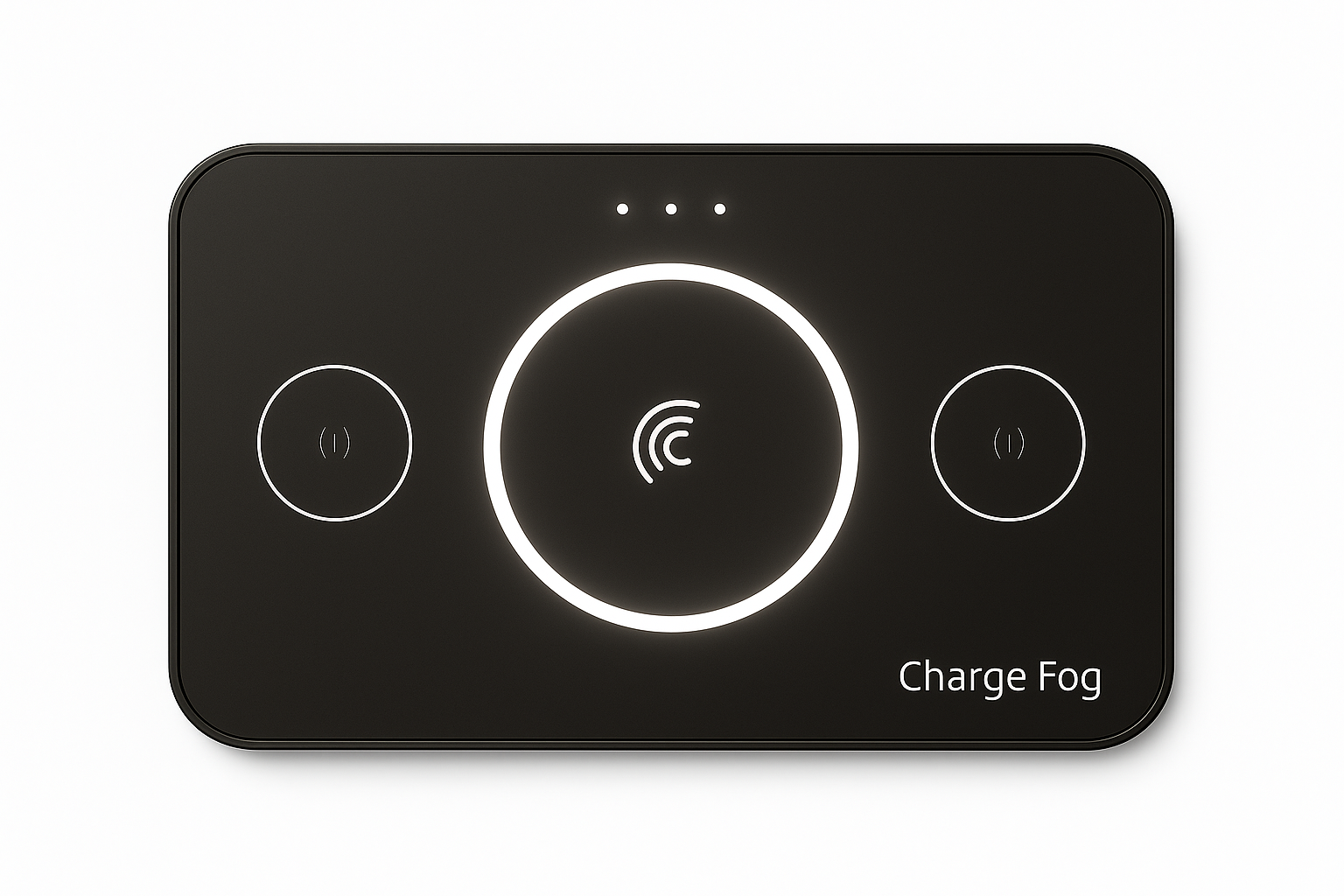
Place your laptop on the Halo Pad and it charges automatically, as if plugged into a high-end USB-C charger. Explore the full Halo architecture on the Charge Fog wireless power technology page.
How the desk becomes a power surface
The Halo system turns a standard desk into a wireless laptop charging surface in two layers:
- Halo Base creates a tightly controlled resonant field under the desk.
- Halo Pad captures that energy and sends 48-V DC to the laptop through the PD Bridge.
From the user’s point of view, the experience is simple: put your laptop down and it starts charging. No cables, no adapters, no branded chargers to borrow. More technical details are available on the Charge Fog Halo technology overview.
Safety, EMC, and global standards
Any serious wireless laptop charger must be designed for real regulatory environments, not just lab demos. Charge Fog’s Halo ecosystem is engineered for safety standards such as IEC/UL 62368-1, thermal limits, foreign object detection, and strict EMC rules in major markets.
As certifications proceed across regions, updates are posted on the Charge Fog certifications and retail partners page, which tracks CE, FCC, UL, RCM, RoHS, WEEE and related approvals.
Real-world spaces transformed by wireless laptop charging
Turning a surface into a wireless charging desk is not just a neat trick. It solves everyday problems in the spaces where people actually work:
- Home offices – a single Halo Pad on your main desk keeps your laptop topped up all day.
- Corporate workplaces – hot desks and meeting tables become universal charging spots for any USB-C laptop.
- Cafés and restaurants – powered tables keep guests for longer without messy extension cords.
- Hotels and lounges – desks and side tables become premium amenities for business travelers.
- Airports and public areas – surfaces turn into clean, cable-free power zones.
You can see example layouts and deployment ideas on the Charge Fog wireless power solutions page, which covers homes, offices, hospitality, retail, and public infrastructure.
Installation, compatibility, and power delivery
One of the strengths of the Halo ecosystem is that it installs with minimal disruption:
- The Halo Base mounts under most wooden or laminate desks and counters.
- Halo Pads simply sit on the surface and can be repositioned as needed.
- PD Bridge receivers plug into USB-C, delivering familiar USB-C Power Delivery to laptops and devices.
For architects, designers, and facilities teams, the Charge Fog technology page includes guidance on materials, thickness, clearances, and best practices when integrating wireless laptop charging into new builds.
Why 48-V power matters
Many early “wireless chargers” were never designed for real computers. They top out at phone-level wattage. A modern creator laptop, gaming notebook, or developer machine can easily draw 65–100 W.
By centering the platform on a 48-V power bus, Charge Fog can:
- Improve efficiency versus low-voltage, high-current designs.
- Reduce heat in coils, pads, and electronics.
- Scale a single Halo Base to more pads or larger work surfaces.
- Align with proven 48-V infrastructure used in telecom and data centers.
This is why the Halo ecosystem feels like a dependable wired dock while delivering the convenience of truly wireless laptop charging.
The future: data-driven wireless workspaces
Once power becomes part of the surface, it can also become part of the data layer. Over time, Charge Fog plans to unlock anonymous analytics around workspace usage, charging behavior, and battery health.
This data will help IT teams and facility managers understand how spaces are used and how devices behave in the real world. The analytics roadmap and data business model are outlined in more detail on the Charge Fog investors and strategic partners page.
How to get started with Charge Fog
Whether you’re equipping a single home desk or deploying wireless laptop charging across a network of cafés, offices, or hotels, Charge Fog can scale with you.
- Explore the full Halo ecosystem on the Charge Fog wireless power technology page.
- See how Halo Pads fit into real environments on the Charge Fog wireless power solutions page.
- Follow certification and retail updates on Charge Fog certifications and retail partners.
- Interested in joining the team in Cebu or remotely? Visit Charge Fog careers in Cebu and remote.
To talk directly with the team about pilots, partnerships, or pre-orders, contact Charge Fog Inc..
Charge Fog Inc. is a Wyoming-registered C-Corporation building the world’s first 48-V wireless power platform for laptops and high-demand devices, with manufacturing and assembly based in Cebu, Philippines.
Learn more at chargefog.com.